PHOTOGRAPHIC ‘MUCK-STICK’ SAFETY
by Ian Robertson, 2015
Introduction
A photographers ‘muck-stick’ (a 6 mm dia stainless steel or dural rod about 300 mm long) is an essential part of our photographic gear now, especially when shooting macro.
It has multiple uses, such as a ‘monopod’ point steady to avoid reef damage, or as a means of rolling over small stones to see what lies beneath without getting too close to blue-ringed octopi or cone shells, or even just for digging into the sand as an anchor in a strong current.
When not in use, it is generally carried on a wrist lanyard or stuffed up a wetsuit sleeve. What has worried me for a while is that tricky act of entering or leaving the water while dangling something that, although not actually sharp, could easily penetrate the rib cage, stomach or a leg, in a fall, with unpleasant or even career-limiting consequences.
A Solution to the Problem
An obvious place to stow the ‘muck-stick’ is on the camera baseplate (Figure 1), where it is less likely to do harm. But how can we make it both secure and easily accessed? The answer is a pair of dedicated clips (Figures 1 and 2). I made these about a year ago and they have been a resounding success. I’ve made two more installations since, for dive buddies. It just needs a little bit of discipline to stow the ‘muck-stick’ on the camera base-plate at the safety stop, as I close down the camera at the end of the dive.
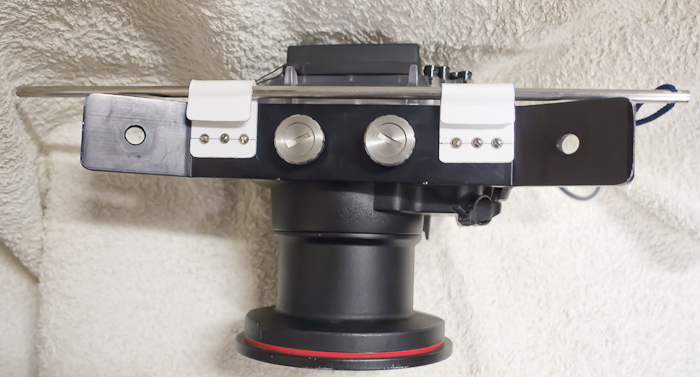
| Figure 1. The installation |
Manufacture
The two clips are made from a piece of PVC plastic sheet about 1.5 mm thick (Figure 3). These are molded and bent with a heat-gun. PVC is ideal, as it molds and bends very easily when hot, though other, similar plastics will do. Practice with the heat-gun on a few bits of scrap first! The clips, once molded and bent, are adjusted while hot so they hold the muck-stick firmly when cold. The clips are then drilled and attached to the camera base plate with stainless steel bolts. It is essential to use marine-grade stainless steel as seawater plays merry hell with anything else.
 |
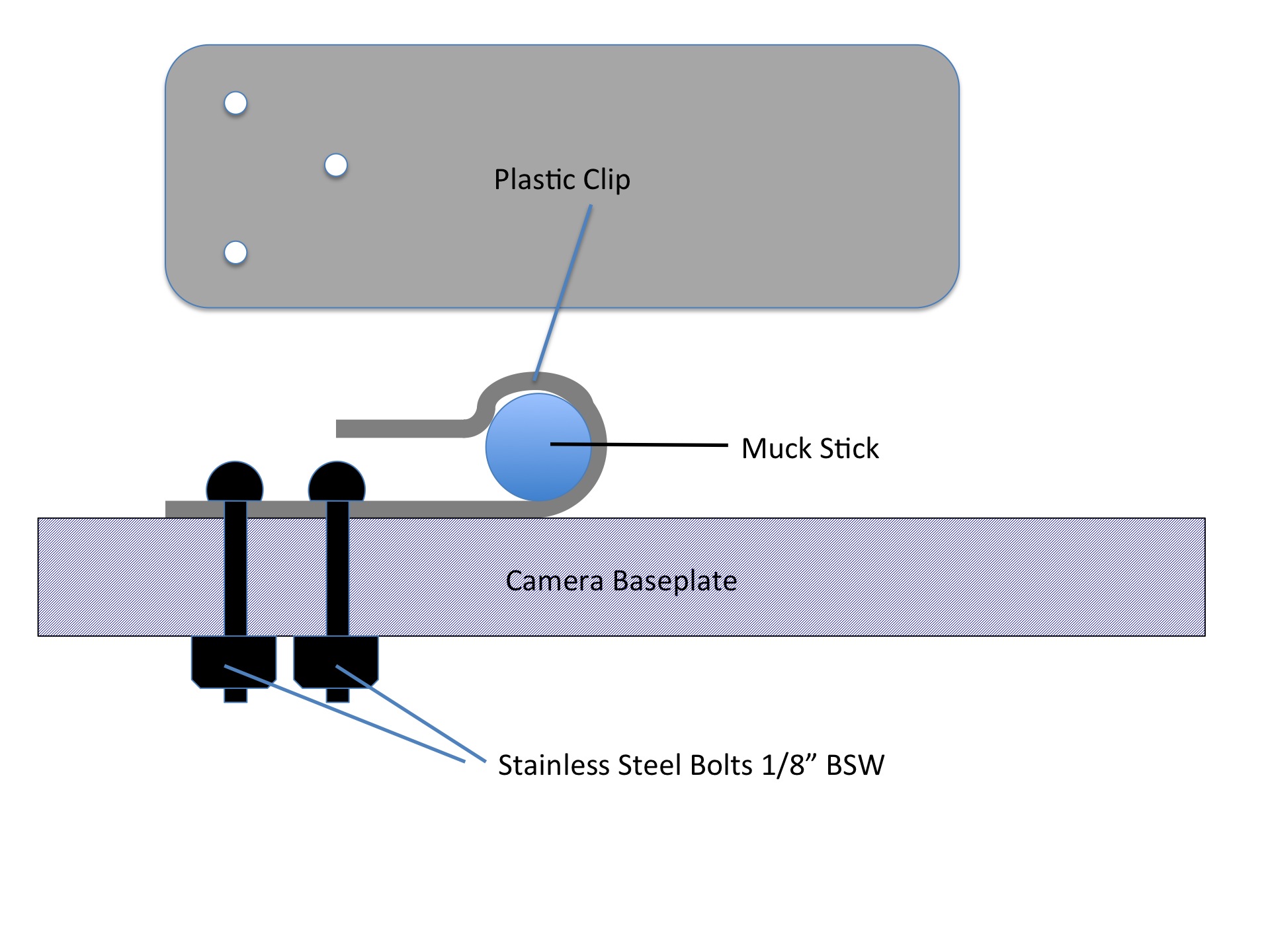 |
| Figure 2. Detail of the Clip | Figure 3. Drawing of Clip and Baseplate |
Materials and Tools
You get grey or white PVC from the plumbing or reticulation aisle in your hardware store, where it is used in pipe-fittings and pipes or it is easily scrounged, by the more adventurous, from a dumper bin on a building site. The bolts come from your local yachting store. Tools you need are a drill, a small hacksaw, a fine file and a heat-gun (a bit like a hair-dryer on steroids). The photos and diagrams tell all. Remember to remove and replace the ‘muck-stick’ by pulling it out along its length.